Preface
What began only as an idea for a brief essay on a physical analogy to the context of words has become a webpage full of tangential notes and a bibliography of helpful works on interpretation! Before presenting the analogy below or any details concerning interpretation, I must first explain what Context means in the title of this work: Although I’ll use the term literary context as differing from a physical or environmental context, by literary I do not mean a context that must be based only upon the written/printed or spoken words themselves. The term literary context here would also cover the history, culture and experiences that a piece of literature’s author had in mind for its intended readers, including an understanding of the physical environment in which the author composed those words or knew that its intended readers would be familiar with. So, it is not isolated to only the study of a work’s literary facets.
Introduction
Someone yells out the word “fire!” (or feur in German, or pur; πῦρ in Greek)[1] and you will likely immediately think of something very specific if you’re in an enclosed public gathering. But if you heard that word uttered in a normal tone; instead of being exclaimed by someone, they may only be describing something we call “fire” or if in the form of a question, simply asking if a fire should be built for warmth. Yet even the exclamatory use of “fire” in a different physical location or situation can completely change the meaning of just that single word: What would it mean if the captain of a ship exclaimed it while the crew was at battle stations?
The point above is that a simple word such as “fire” can have at least three completely different meanings depending upon the physical context surrounding its use. And this is similarly true for how we must discover the meaning of any written/printed word[2] from its literary context! The following paragraphs are only some of the thoughts I’ve had about the meaning of words; which I decided to collect together in this essay after reading a scientific description of neutrons as an example of environmental context.
A Contextual Analogy: The Neutron
This paragraph provides a basic description of an atom in order to understand the analogy: Atoms are comprised of what can be thought of as an outer cloud of one or more electrons, and a nucleus comprised of protons and neutrons (except for the most common form of hydrogen; its nucleus consisting of only a single proton).[3] Electrons have a charge of -1e and protons +1e, but neutrons have no charge; as their name implies, they are neutral. Protons and neutrons have quite similar masses, but electrons have 1,838 times less mass than a neutron, so are almost negligible for the total mass of an atom! Lastly, atoms are mostly empty space: Every type of atom is about 99.9% empty space![4]
The neutrons inside of stable (non-radioactive) atoms or ions (atoms that have lost or gained one or more electrons, giving them an overall positive or negative
charge) will remain unchanged in that atom's nucleus basically forever; the majority of them are still in the same atoms they were in since Creation! But here's a fact that very
few (outside fields involving particle physics) know: A neutron if ejected from an atom and prevented from interacting with any other particles, can only last at most for about
14 minutes all on its own. After that, it will break apart into a proton, an electron and an anti-neutrino![5]
Some physicists when commenting on this phenomenon have used the phrase, "Context is everything!" and describe it like this: The same type of particle that can't last
even 15 minutes alone, has been sitting comfortably inside nuclei for as long as our solar system has existed. How can the same particle be violently unstable in one context and
perfectly stable in another? It's because this is not a difference in the neutron itself. It's a difference in where the neutron is. Context is everything!

The Analogy: Just as every neutron (to be called a neutron) must have no charge, the same mass, etc., for a word to be called this or that word in order to refer to it in some passage, we note how it is spelled (or symbolized) in the language being used; especially if you wish to use some lexical tool to learn more about that word.[6] And, just as a neutron can behave in two entirely different ways depending upon its environmental context, the same word can have completely different meanings depending upon the literary context it is found in!
To carry the analogy as far as one can, think about the neutron in what follows as if it were a word or phrase in a literary work or speech:
You cannot
understand the behavior (meaning) of a particle (a word) without understanding its environment (its context). A neutron is not simply stable or unstable as an inherent fixed
property. Its stability (or meaning) depends entirely on what system (context) it's part of. Strip it from a nucleus and it dies in minutes! Regarding that
last statement, think about how one might refer to words as being unstable in a different but still somewhat similar analogy: Words can lose their
intended meaning when taken out of context. Leave a neutron bound inside a stable nucleus (or a word within a specific literary context) and it lives
for the age of the Universe (or some words even beyond that, since Jesus said “Heaven and earth will pass away, but my words will not pass away.” —
Matthew 24:35; ESV. Cf. Isaiah 40:8 and 1 Peter 1:25). The laws that God set for this nucleon do not change. Only the context changes. And the context is
everything.[7]
Determining Meaning
How do you know what a person means by what they say, write or have put in print? How many times have you asked someone in person or replied back about some social media post, “What exactly did you mean by that?” In a classroom setting or certain types of lectures, there should be time for questions about the material presented. And a good teacher will ask questions which stimulate feedback in order to asses whether students have understood the material as the teacher intended.[8]
But what can we do if a speaker we're listening to or an author of what we're reading is dead? For video presentations we have both sight and sound to gather extra information from, or for an audio message, at least the changes in their voice. But no matter what form of media was used to communicate their thoughts to us, we must rely upon increasing circles of context to get the best understanding of what a speaker or author meant by the words they used. These would first include the context and grammar of a particular sentence, then the context provided by all surrounding sentences (in what we might call a paragraph), then a group/cluster of paragraphs we might call a section or even a chapter, then a whole letter or book and even all the other known works by the same author.

But then we must also add whatever we can learn about the geographical locations and cultures of any places or peoples mentioned within those works. Having a greater understanding of the where and when of how authors and their initial readers lived and the cultures they grew up in may be crucial for seeing the meaning that an author intended to communicate in a particular passage. In the very beginning of nine NT books are the city/region names we use in their titles: Rome (Rōmē Ῥώμῃ), Corinth (Korinthos Κόρινθος), Ephesus (Ephesos Ἔφεσος; whether it was in the autograph or not), Philippi (Philippois Φιλίπποις), Colossae (Colossai Κολοσσαί) Thessaloniki (Thessalonikeus Θεσσαλονικεύς) and the region of Galatia (Galatia Γαλατία). And of course, all the additional locations mentioned by Luke in the book of Acts during Paul's missionary trips! And the OT has many prominent countries and cities mentioned in its books as well. Study Bibles (for example, The ESV Study Bible; be sure to click on the "Read sample" button) include introductions to each book, maps and other data to address this lack of background information within the Text itself; though most of them also include comments on the Text itself, so are like having a mini-commentary on each book of the Bible (which one shouldn't consult until after spending much time studying only the Text and its Context). Apart from a Study Bible, a good Bible dictionary (see our section on Tools for Bible dictionaries) or even a multivolume encyclopedia would be a must for learning at least the basics about all these different locations, peoples and their cultures. Decades ago, I used Today's Handbook of Bible Times and Customs (©1984, Bethany) by William L. Coleman for insights into some of the cultural aspects of the people mentioned in the Scriptures. There are also whole books devoted to only the geography and maps of all the lands mentioned in the Bible.
Examples Showing The Importance of Context for Interpretation
Before moving on to some misunderstandings people often have with the TEXT itself when reading or hearing verses quoted without any context, the first examples below are where archaeological finds have resolved minor issues and/or added some important insights into the TEXT. But it must be noted that in general, the Scriptures are not all that difficult to understand concerning its main themes! Ever since the Fall of Adam (see Genesis 3:1-24), much of Scripture, apart from the separating out of "God's people" and the history of Israel, refers to the salvation from sin that God would provide through the Messiah (in the OT, or already had provided for after the death and resurrection of Jesus in the NT) for those who had or will trust in Him. A popular work on this topic was To Understand the Bible Look for Jesus.[9]
How Archaeology Can Inform Us
1. The Hebrew word piym (פִּים) in 1 Samuel 13:21 had been completely unknown until the 20th century:
The Context: 1 Samuel 13:19-21 relates how the Philistines controlled the ironworks industry so the Israelites couldn't make better weapons nor even maintain the sharpness of
their farming tools.
The Discoveries: In 1907, archaeologist Stewart Macalister discovered the word on a stone weight at Gezer (see "AN INSCRIBED WEIGHT" on pages
266-267 of his
report here); but with no mention of v. 21 in 1 Samuel.[10] It wasn't until 1914, after yet another stone weight with piym
on it was found, that these were finally connected to its occurrence in 1 Samuel 13:21 (see A file for the mattocks!? for more details). And just a few years later, Bible translators used this information to make changes to what had been only
guesswork about its meaning for many centuries!
Note: The word pətsiyrāh (פְּצִירָה), which occurs just before piym in this verse, is also used only once in
Scripture whose meaning is still uncertain. But after discovering that piym was a weight that the cost of something could be measured by, using a meaning of
price for pətsiyrāh makes rather good sense. So today, translations based upon these discoveries fit the overall context much better than what
scholars long ago could only imagine this passage might mean. [See also: TWOT, Vol. 2, p. 722, entry 1766b.]
2. Hezekiah’s Conduit (2 Kings 20:20)
This verse gives a brief summary of King Hezekiah's life “including how he built a pool and conduit to bring water into
the city,...” (NET Bible). Without external context, this reads like some public works project of little consequence.
The Archaeological Find: In 1838, the American
Biblical scholar Edward Robinson documented the existence of a 1,750-foot subterranean tunnel chiseled through solid rock, but it wasn't until after the discovery of the Siloam Inscription in 1880 (which details how two teams of workers dug from opposite ends, using the
sound of axes to meet in the middle) that Charles Warren finally connected the tunnel to that of King Hezekiah on page 384 of this 1884 publication. Thus, this discovery of the actual "conduit"
of monumental engineering along with the wider Biblical context of both 2 Kings and 2 Chronicles relating this to the invasion of Judah by the king of Assyria (“Hezekiah
dammed up the source of the waters of the Upper Gihon and directed them down to the west side of the City of David.” — 2 Chronicles 32:30; NET Bible — another
reference to how they redirected the city's entire water supply inside the walls before the siege) shows why this was a very important achievement for everyone living in Jerusalem
and something the author of 2 Kings understandably considered very significant in the life of Hezekiah.
Further references: Though many proposed that the workers followed and
widened an already existing underground cavity called a karst, this
study "demonstrated that ST [the Siloam Tunnel] must have been engineered and hewn by man without a pre-existing natural conduit." See also Hezekiah's Tunnel.
3. The Riot Over a "Meteorite"
In Acts 19:23 ff., we read that Paul's preaching caused a massive city-wide riot in Ephesus. After two hours of this, the town clerk finally shouts out before the angry
mob: “Men of Ephesus, what person is there who does not know that the city of the Ephesians is the keeper of the temple of the great Artemis and of her image that fell from
heaven?” (Acts 19:35; NET Bible)
First, it must be pointed out that the word "meteorite" in our title and elsewhere here is the conclusion of current scholarship based upon the Text in Acts and all the
other ancient literature describing similar objects placed in other temples (such as the Temple
of Cybele). But, none of these locations, including Ephesus, have ever yielded any physical evidence of an actual meteorite. It's still a very good assumption though.
Why did a city official need to calm a political riot by talking about something that fell out of the sky and was turned into a statue? What does this have to do with Paul, and
why did the people of this geographic location react so emotionally on such a large scale to his message compared to other cities?
The Geographic Context: Ephesus was the geographic custodian of the Temple of Artemis, one of the
Seven Wonders of the Ancient World. It was four times larger than the Parthenon in Athens, and the city's entire economic infrastructure depended upon the religious tourism
associated with this temple. It was the epicenter of an entire industry based upon that meteorite: Centuries earlier, according to some ancient literature, a black meteorite
had crashed into that geographic region. And because it vaguely resembled a multi-breasted female figure, the locals worshiped it as a divine image sent to them by the gods
("fell from heaven")[11] and built a massive temple around it. So, Paul wasn't just preaching a theology of little or no interest to
the Ephesians; he was using their highly lucrative meteorite cult as an example when saying that “gods made by human hands are no gods at all” (Acts 19:26). This
historical information explains the panic: If Paul's message had been widely accepted in that region, it would have become an economic disaster for almost everyone in Ephesus.
4. Who was the Mysterious Erastus, the City Director of Public Works
The Text: At the very end of his long letter to the Romans, Paul drops in a list of greetings from people who had been with him in the city of Corinth. Among them, he notes:
“Erastus, the city treasurer, ... greet you.” (Romans 16:23) Is there any particular reason why Paul included the title of a local civic bureaucrat in his letter? For
centuries, critics argued that this was a fictional detail or that the Early Church only consisted of the poorest, most uneducated slaves of society who would never hold
a political office reserved for the 'upper class'.
The Archaeological & Historical Facts: In 1929, archaeologists excavating the ancient theater area in Corinth made an astonishing discovery. They unearthed a large, 1st-century
Roman plaza paved with limestone blocks. Carved deeply into one of the massive stone paving slabs is a Latin inscription dating precisely to the mid-first century. The inscription
reads: "ERASTUS PRO AEDILITATE S P STRAVIT" which has been translated as: "Erastus, in return for his aedileship (a Roman term, not fully translated), laid
this pavement at his own expense." In the Roman political system, an Aedile was the high-ranking elected official responsible for public buildings, streets and
civic funds — a good match to Paul's Greek description (ho oikonomos tēs poleōs; ὁ οἰκονόμος
τῆς πόλεως); the city treasurer, who would have been in charge of public funds and properties. The context argues for
Paul expecting his Roman readers to find this greeting meaningful, since Erastus would have been a well-known Roman official who had converted to Christianity. In the ancient
Roman world, when someone was elected to high office, they were expected to fund public infrastructure (like paving a plaza) out of their own pocket as a gift to the city. This
archaeological artifact proves that Paul's network also included at least one Roman official, and anchors the closing remarks of Romans to a literal, physical piece of
stone you can still see in Greece today.
5. “Our citizenship is in heaven”
Paul wrote to the church at Philippi: “For our citizenship is in heaven, from which also we eagerly wait for a Savior, the Lord Jesus Christ” (Philippians 3:20; NAU).
So, why would Paul use the legal term "citizenship" in a spiritual letter? Why would he tell a church in Greece that they are citizens of a completely different
kind of existence?
The Historical and Archaeological Facts which Shed Light On This:
In 42 BC, the Roman Civil War battle between Mark Antony/Octavian and Julius Caesar's assassins (Brutus and Cassius) took place on the plains of Philippi. After winning, Octavian
disbanded his veteran legions, gave them land and turned Philippi into a premier Roman Colony. Archaeological excavations at the site have unearthed Latin civic inscriptions and
Roman architecture designed to mimic Rome itself. As a colony, the citizens of Philippi were legally granted Ius Italicum (The Law of Italy). This meant that even though
they lived thousands of miles from Italy, they enjoyed full Roman citizenship, exempt from Imperial taxes and were actually governed by the laws of Rome. They were fiercely and
nationalistically proud of this. They viewed themselves as an outpost of Rome in a foreign land. And Paul, obviously, had no need to explain any of that to the Philippians.
The Meaning Made Clear
So, Paul uses their exact civic reality as a brilliant metaphor: Just as you are a literal physical colony of Rome, though living in Greece, your church
is a colony of Heaven living on earth! Furthermore, the Roman Emperor was officially titled Soter (Savior) on Roman coins and inscriptions. When Paul says they were waiting
“for a Savior [from Heaven], the Lord Jesus Christ” he is using explicit anti-imperial imagery that his readers would immediately recognize as a statement of allegiance
to Christ before any earthly ruler.
6. The Geography of the Seven Churches of Revelation: For now, I'm leaving this as a research project for all my readers! Write
down the locations of those churches, and study whatever you can about their local cutures and geography. Then look for anything in the words of Jesus concerning each church that
your geographical studies might show how those words were more meaningful to each church.
These Should Have Silenced the Critics
Before moving on to literary only examples, you should know that in the late 1800s, Bible critics; especially in Germany, considered many of the events
written as history in the Scriptures to be outright fiction and fables about non-existent peoples! Each of the following references to major archaeological discoveries in the
20th-century, show that what was recorded in the Hebrew Scriptures was historical fact; not someone's imagination:
1. The Hittites. Solid evidence was found from 1906-1912, when thousands of tablets in a Royal archive were discovered; some written in Akkadian, but most of them
in an unknown language. In 1915 those tablets began to be deciphered as the Hittite Language and that
location (Hattusa) as the capital of the Hittite Empire; see also: The Hittite Archives.
2. .
MORE TO BE ADDED LATER!
Using the Context of Scripture Itself
There are many passages which can cause confusion when removed from their surrounding context. Apart from those here, you can find examples in Carson's, Exegetical
Fallacies found in our Recommended Books section below which lists some of the passages that have been taken out of context in attempts to
twist the meaning of Scripture.
1. The Parables of Jesus are a great example of how context informs us of the nature of certain passages in the Bible: The word parabolē (παραβολή) is used 48 times in the Synoptic Gospels (17 times in Matthew, 13 times in Mark and 18 times in Luke)
to describe some of the teachings of Jesus; usually narratives of many verses in length, full of metaphors or similes and symbolism, rather than a reference to a
real person or historical event (such as when Jesus refers to the “eighteen on whom the tower in Siloam fell” in Luke 13:4). Matthew 13:10-23 is a full explanation about
why Jesus used parables and then provides the meaning of Matthew 13:1-9 (Parable of the Sower). Scholars differ as to the exact number of parables, since some consider the
shorter sayings of Jesus (cf. Matthew 5:14-16) as only similes (labeled "Similitudes" in the section headings of some Bibles) rather than parables.
2. The Legal Meaning of "Spitting in the Face" (Reading Numbers 12 in light of Deuteronomy 25)
The Setting: In Numbers 12, Miriam rebels against Moses, and God strikes her with leprosy. Moses begs God to heal her. God replies in part: "If her father had only spit
in her face, would she not have been disgraced for seven days? Shut her out from the camp seven days..." (see Numbers 12:14). Taken all by itself, this appears to be only an
emotional response about a father who was disgusted with his daughter. However, turning to Deuteronomy 25:7-10 (regarding Levirate Marriage), verse 9 (“spit in his face”)
shows this was a formal, legally binding public ritual of disinheritance and legal shaming for violating a family covenant. So, when God uses that phrase in Numbers 12, it was a
reference to a known legal framework; not an emotional insult. He was telling Moses that Miriam committed a legal breach of the family hierarchy, and added that this should require
a formal, 7-day period of legal banishment.
3. Eating Flesh and Drinking Blood
The Baffling Passage: “Truly, truly, I say to you, unless you eat the flesh of the Son of Man and drink His blood, you have no life in yourselves.” (John 6:53)
Really?! Without context, this sounds like one of the most atrocious propaganda accusations made against early Christians by the Romans!
The Context: The entire chapter of John 6 is a large and unified debate about food (you'll soon see what I mean by that). Its background actually begins with Jesus physically
feeding 5,000 people with literal bread in John 6:1-14. Then Jesus spends most of the chapter trying to shift their minds from the physical to a spiritual reality (verse 27 makes
this clear: “Do not work for the food that disappears, but for the food that remains to eternal life - the food which the Son of Man will give to you.” (NET Bible). He
also compares himself to the Manna that Moses gave the Israelites in the desert (John 6:32-33); followed by “I am the bread of life” in verse 35. When reading the whole
section, you should realize that the phrase in question is a metaphor that Jesus explicitly defined: “The one who comes to me will never go hungry, and the one who
believes in me will never be thirsty.” (John 6:35b) So, eating his flesh (and drinking his blood) means to accept and fully internalize the salvation that his upcoming
sacrifice on the cross would provide by faith given to those who believe (cf. John 6:65). It has nothing to do with physical bread nor the physical body of Jesus. The chapter
concludes with many ignorantly rejecting this teaching, but the Disciples confirming their belief in Jesus as “the Holy One of God” (John 6:69).
It must be noted that this chapter is an important Scriptural commentary on Matthew 26:26-28 (cf. Mark 14:22-25; Luke 22:19-20); which some have used as support for taking as
literal what Jesus himself showed us to be spiritual and metaphor (as “I am the door” is in John 10:7), and what would have been in the minds of
his Disciples at the "Last Supper." However, as the Apostle Paul added, this does not mean that anyone should ever treat the institution of Communion in the Body
of Christ in a careless manner (see 1 Corinthians 11:23-32).
4. 2 PETER 1:20 in the King James Version (1769 Blayney Edition; KJV) reads: “Knowing this first, that no prophecy of the scripture is of any private
interpretation.” And the Geneva Bible (1599), the ERV (1885) and the ASV (1901) all use the phrase “private interpretation” as well. When read all by itself, this
verse sounds like a warning to the reader of the Bible. And for centuries, it had been used by those in hierarchical positions to argue that everyday people have no right to read
and interpret the Bible on their own. So, many think this verse means you must rely on church leadership to tell you what the Scriptures mean.
However, if you read the immediate surrounding context; even just the prior verse, the actual meaning of verse 20 shifts entirely. It has absolutely nothing to do with how we read
the Bible today, but rather where the Prophets got their prophecies from! Read 2 Peter verses 19-21 in any version. What are these verses about? They concern where the words of
the Prophets came from and their reliability! “Moreover, we possess the prophetic word as an altogether reliable thing. You do well if you pay attention to this as you would
to a light shining in a murky place, until the day dawns and the morning star rises in your hearts.” (2 Peter 1:19; NET Bible) and “for no prophecy was ever borne of
human impulse; rather, men carried along by the Holy Spirit spoke from God.” (2 Peter 1:21; NET Bible) make it quite clear; especially the "for no prophecy..." at the start
of verse 21, that Peter is talking about the origin of Scripture's prophecies, not how reader's interpret them! For more on this, see my page The Importance of Context.
5. JOHN 8:32 — When Jesus brought up the word “truth” in a reply to Pilate, was that simply truth in general? (See The
Context of John 8:32 in our “What is Truth?” article.)
Endnote
In order to establish (or come as close as possible to) the meaning of the words and the passages in which they occur in some body of literature; such as those in the
Hebrew, Aramaic and Greek Scriptures known as the Old and New Testaments, we must never read into them some predetermined idea! Everyone, not only Biblical
scholars and pastors, should be exegetes (related to the word exegetical in certain Bible commentary titles),[12] who draw the original, intended meaning out of a text through objective analysis of its context, grammar, history, etc.
Dictionaries, lexicons, encyclopedias and exegetical commentaries are tools that are supposed to help us discover the meaning of a Text; not to be used as a
means to pick and choose only those meanings we prefer due to preconceived beliefs; which for some, as the oft spoken aphorism (or proverb) states, "is easier said than
done" (and impossible for any individual or group whose distinctive set of beliefs were already decided upon and have attempted to inject them into Scripture,
rather than being drawn out of Scripture[13]). So, please be sure to take the time to first study and understand, then pass along or
teach what God intended for us to learn from the Scriptures; not merely religious traditions nor your own preconceived notions.
Recommended Books & Videos
Note: I do not necessarily agree with all the details or conclusions of every work referenced here (especially Wikipedia or any other site for which it would be impossible to fully review; including Got Questions[B1] or any others which I've linked to in my footnotes and elsewhere here).
Interpretation, General
E.D. Hirsch, Jr., Validity in Interpretation (©1967; Yale University). Summary: The central argument is that a Text's true meaning is inextricably linked to the author's original intentions. Hirsch wrote this during a period in academia when "New Criticism" and structuralism were gaining a lot of traction, and many theorists believed a Text should be viewed in total isolation from its author (known as semantic autonomy). So he built a rigorous defense of objective literary analysis, arguing that textual interpretation can claim genuine validity only when it successfully uncovers what the author consciously meant. The core concepts in the book are "Meaning" versus "Significance" where the determinate sequence of words as intended by an author and embedded in the linguistic and historical conventions of their era have a meaning that is fixed and unchanging. But any significance a Text may have in a reader's personal, cultural, or historical context is mutable and can change over time. Although one may not be able to achieve absolute certainty in the interpretation of a particular Text, we should use all the linguistic (e.g., identify its genre, etc.), historical and biographical tools available to obtain an interpretation with the highest degree of probability.
Interpretation, Biblical
Moisés Silva, Biblical Words and Their Meaning: An Introduction to Lexical Semantics (©1983, Zondervan); highly recommended. There's also this Revised and Expanded edition (1995). Summary: A foundational guide which introduces students and pastors to modern linguistics; specifically lexical semantics (the study of how words convey meaning). It provides tools for responsible Bible interpretation by teaching readers how to accurately handle Greek and Hebrew words without falling into common translation traps.
D. A. Carson, Exegetical Fallacies (©1984; Baker Book House). Carson refers to Silva's work a number of times. There's also this Second Edition (1996) and even a Third Edition to appear in AUG, 2026.
Carson made this introductory comment that should be taken to heart by Believers in any leadership capacity: “Many local Bible teachers and preachers have never
been forced to confront alternative interpretations at full strength; and because they would lose a certain psychological security if they permitted their own questions, aroused
by their own reading of Scripture, to come into full play, they are unlikely to throw over received traditions.” (p. 15/19)*. More comments from the Intro:
“Hermeneutics, linguistics, literary studies, greater grammatical sophistication, and advances in computer technology have joined forces to demand that we engage in
self-criticism of our exegetical practices.” (p. 17/20). But he also points out that focusing on fallacies can be dangerous (“persistent negativism is spiritually
perilous.” p. 19/22). It may lead to either pridefulness or discouragement, and it takes a lot of hard work to balance the intellectual details of such a study with its
spiritual benefits.
*The Page numbers "(p. x/y)" refer to 1st edition (x) and 2nd ed. (y). The Introduction to the 2nd Edition can be read in full by
taking the link above to Amazon and using the "Read sample" button!
Tools for Biblical Interpretation
For some, such as seminary professors or pastors who give exegetical sermons weekly, works like those below are a daily necessity. Many of these are available in
commercial Bible Study programs; such as Accordance (but only for Macs not PCs) or Logos (a number of us still use the discontinued BibleWorks program though). For non-professionals, I'd
recommend checking to see if they are available in your church or local libraries (is there a seminary near you?); unless cost is no problem:
NT (to use these tools, you should have at least mastered the Greek alphabet):
A Greek-English Lexicon of the New Testament and Other Early Christian Literature, Third
Edition by Frederick W. Danker, Walter Bauer (Copyright © 2000 by The University of Chicago Press; often abbreviated as: BDAG). In the "Conclusions"
of Silva's first edition of Biblical Words... (pp. 171-177), he commented on what he saw as deficits in an earlier edition (not this one edited by Danker) which have been
addressed in this revised edition.
Greek-English Lexicon of the New Testament, Based on Semantic Domains,
Volume 1, Introduction & Domains (Copyright © 1988, United Bible Societies; UBS) Ed.s: Johannes P. Louw and Eugene A. Nida. And: Volume 2, Indices.
A Manual Greek Lexicon of the New Testament, G. Abbott-Smith (1922,
T. & T. Clark, but many reprints). The main reason for mentioning this book is because the entries often include Hebrew words that the Greek is associated with in the OT. And
you can read, search or even download a free copy from here. (BDAG is much much better, so save up
to buy that one if you really want a physical reference book.)
OT (and for these tools, you should be familiar with the Hebrew alphabet):
For now, I'll advise reading through this article on what's available: Hebrew and Aramaic
Lexicons.
Theological Wordbook of the Old Testament, Two Volumes
(©1980, Moody Press; often abbreviated as: TWOT); Editor: R. Laird Harris, Associate Ed.s: Gleason L. Archer, Jr. and Bruce K. Waltke with 43 other contributors.
A single volume edition has been available since 2003. The quality of the entries/articles varies though; some are excellent, but others disappointing. (Note: For those who are
still struggling with the Hebrew alphabet, there's an index at the back of Volume 2 which gives the TWOT entry # for any Strong's number; or an asterisk [*] which
indicates that word is absent from TWOT.)
A History of the Biblical Languages and Lexicography; a YT video by Cross Bible (2025). Its
title actually begins with "Greek vs Hebrew:" which is misleading. It is a detailed history, first of how the Hebrew and then the Greek Scriptures came down to us, then
the most important parts you must watch to understand all the rest: "Modern English Lexicography (11:36 ff.)" and "Words, Tokens and
Lemmas (13:26 ff.)," followed by how all the Greek lexicons that have been produced (including those for Biblical studies) were created. It's over an hour long,
so I recommend clicking on the more link underneath the video and using the links to watch those two important chapters and then whatever interests you the most instead
of trying to digest all of it in one sitting! [Note: The CrossBible website is not free to use except for Bible reading, and many of its other videos are like ads for the
paid part of the website.]
Tools That Do Not Require Any Language Familiarity:
The New Bible Dictionary, Second Edition (©1982 by Tyndale); edited by: J.D. Douglas, F.F, Bruce, J.I. Packer, and others. Publisher's summary: "Identifies people, concepts, and doctrines in the Bible, and provides background information about the history, geography, customs, and cultures of the Middle East."
Important Topics for Anyone Studying the Bible:
Benjamin L. Merkle and Robert L. Plummer, Greek Word Studies for Everyone:
An Easy Guide to Serious Study of the Bible (©2025; B&H Academic).
Watch this video interview of Rob Plummer (by Stephen Hackett) explaining what's in the book:
The Exegetical Fallacies Nobody Warns You About. This includes comments on: The Context Fallacy
(taking a passage or phrase out of context), The Etymological Fallacy, Grammatical Fallacies, etc.
Note: Near the end (38:30 ff.), there's an
important discussion for Greek teachers and scholars about Stephen's nerdy question concerning the Perfect Tense. Plummer refers to a study by Rutger J. Allan on
Tense and Aspect in Greek (free; and various
sites can be used to convert it to a searchable document); which Plummer then illustrates using his story about a snowball rolling down a hill. The study can be summarized
as the development of the Greek perfect tense in three stages: 1) PIE/Homer — The perfect refers to a present state resulting from a past action. 2) Post-Homer — The
perfect develops a meaning of a previous action with current relevance. 3) Late Greek — The perfect acts similarly to the aorist, indicating past action without reference to
the present. The Koine Greek of the NT is considered part of this 3rd stage. (The very nerdy may wish to skim through another free article titled, Development of the Imperfect in Ancient Greek, since it contains a number of
comments on all the tenses, including their use in Koine Greek.)
Robert H. Stein, Difficult Sayings in the Gospels: Jesus' Use of Overstatement and Hyperbole (©1985; Baker Book House). Summary: Jesus used exaggeration in his teachings. Stein defines hyperbole as exaggeration that is literally impossible; whereas, overstatement is a lesser exaggeration that can be literally possible, but not likely. Having a log protruding from your eye (Matthew 7:3-5) is hyperbole. Forgiving your brother seventy times seven (Matthew 18:22) is overstatement. For more examples, see here.
J. Robertson McQuilkin, Understanding and applying the Bible (©1983, Moody Press), or: Understanding and Applying the Bible: Revised and Expanded (©2009, Moody Publishers); see "Read sample" pages there.
Bob Smith, Basics of Bible Interpretation (©1978 by Robert W. Smith). Here's a free PDF file of basically the same book from the Peninsula Bible Church: Basics of Bible Interpretation: Words to Live By (©2003, Discovery Publishing).
Roy B. Zuck, Basic Bible interpretation (©1991, SP Publications, Inc.). This book emphasizes a grammatical-historical approach, teaching readers to bridge the gap between observation, interpretation, and application by focusing on the original author's intended meaning for the original audience.[B2]
Personal (or Small Group) Bible Study
Rick Yohn, First Hand Joy (©1982, NavPress). Summary: A practical guide designed to teach readers the inductive Bible study method. It functions as a
hands-on training manual, using short exercises in each chapter to help Believers move past superficial reading and confidently dig into Scripture on their own. It's written in
a clear, concise format, that breaks down otherwise complex or overwhelming study methods into manageable, everyday practices. It's premise is that learning to uncover spiritual
truths directly from the text (rather than relying solely on commentaries or sermons) deepens your faith and brings greater joy to your devotional life.
Rick wrote another small
book titled, Explore the Bible Yourself: A Hands-On Guide to Understanding the Scriptures
(©2011, Heritage Builders Inc.), which may be an updated version, but I don't have a copy to compare them. From publisher: "Yohn believes there's nothing more
rewarding than the firsthand discoveries you can begin to make right now in any book of the Bible. You'll learn to observe a passage. Interpret it. And then apply it. All without
the need for commentaries or someone else's “expertise.” God Himself becomes your teacher. When you or your group are ready to experience God's Word in a new way,
here's where you'll want to begin."
Irving L. Jensen, Independent Bible Study: Using the Analytical Chart and the Inductive Method (©1963, Moody Bible Institute). A Guide to Personal Study of the Scriptures. This work was also revised in 1992; with the words "Chart Your Bible Study" on the cover. It is often referenced by other authors writing on this topic. (Note: One questionalbe source at Amazon is charging way too much for just a paperback edition! Look in thrift and used book stores.)
Elementary Particles
Dr. Jason Lisle completed a 6-part series in 2022 from Introduction: Atoms, Why Quantum?, Wave Nature of Matter to Leptons, Quarks, Baryons, Mesons and Bosons. He also did an earlier 4-part series (in 2016) at ICR with Dr. Vernon R. Cupps on the Subatomic Particles: Leptons, Baryons, Mesons and Bosons. (See also, Wikipedia: Subatomic Particles.)
Glossary
A glossary is an alphabetical listing of specialized, technical, or uncommon terms with a definition of how they are used in a specific book (most often a textbook for a particular technical or scientific field) or a document, and located at the end of a text.[G1] This glossary also includes some selected terms used in the Recommended Books and Videos section and other Biblical literature.
anachronism — (from ana- "against" or "back" and chronos "time"). It is a chronological error in which an object,
event or custom is placed outside of its proper time period. You have an anachronistic view of Scripture when you interpret a passage according to your own modern-day
cultural background rather than the cultures of those being spoken to or written about in Scripture. Because it was written thousands of years ago, readers today often mistakenly
judge the actions, laws and words by current standards; even to the point of injecting their preconceived ideas into its passages. You must be very careful not to judge what you
read in the Bible by current economic, political or scientific standards. "Modernized" Bible translations aren't much different than say medieval paintings which
anachronistically showed Biblical scenes with castles and knights and everyone dressed in Middle-Ages garb. How many sermons have placed the erroneous picture of explosions in
listeners minds by saying we got the word dynamite from the dunamis (power) of the Holy Spirit?!
The 1611 AV contains a number of anachronisms; including: The use
of the word "Easter" in Acts 12:4 as the most obvious. But there are also the candlesticks (Exodus 25:31 but cf. 27:20; Revelation 1:20; it wan't until the
8th-10th centuries that anyone in the Middle East began to use candles), brass (Deuteronomy 8:9) and carriages (Acts 21:15); none of these things existing at those
times in the Bible. Also the use of church for ekklēsia (ἐκκλησία; assembly, congregation
and church — mainly because it was already used as such in many other translations, including the 1599 Geneva); except in Tyndale's NT (1534) for which he insisted
on using “congregacion(s)” 120 times in his translation! There's also its use of "Bishop" for episkopos (ἐπίσκοπος); overseer, guardian, supervisor in 1 Timothy 3:1-2; Titus 1:7; 1 Peter 2:25 (but also as such
in Tyndale, Geneva and even the ASV). But there are many anachronisms in modern-day paraphrase versions of the Bible, for example, "flashlight" (Psalm 119:105),
"toilet" (1 Kings 18:27) and many slang words and colloquialisms in Kenneth Taylor's TLB (The Living Bible; not to mention what more recent paraphrase versions
have done).
cognates — Words or morphemes in two different languages that share a common root they are both derived from. Examples: Brother
(English)/Bruder (German), house (English)/Haus (German) and سلام salām
(Arabic)/שלום shalōm (Hebrew) are all cognate pairs. But note: Cognates are not required to convey the same thing;
the meaning of either word may have changed over time.
Context — Primarily a reference to the meaning of words within a phrase, sentence, paragraph or whole literary work with respect to its
language’s grammar, syntax and genre, but in this work, in order to understand such meaning, context would also include any information about its author's,
intended recipients, shared cultures and specific experiences, histories and even physical locations. Anything which might help one in understanding the intended meaning
an author wished to convey. “This term must be interpreted in the broadest sense possible, from the smallest syntactical detail to...” [Silva, Biblical Words...,
p. 140 under Recommended Books] the shared knowledge a work’s author and readers may have from the past (such as the whole history of Israel recorded
in their Scripture's original language or its Greek translation, the Septuagint, for most of the recipients of the Gospels and letters in the NT).
diachronic, diachrony — Refers to the study of a language over or through time; concerns changes in its historical development. It would
include semantic and phonetic shifts in the language. See synchronic below.
Dictionary — A book containing a selection of words from a language which gives information about their meanings, pronunciations, etymologies, etc. They may also be
referred to as lexicons, though recent Biblical studies usually reserve that word for works on Hebrew/Aramaic and Greek words. A work back in 1889 by William D. Whitney
used both "Dictionary" and "Lexicon" in the same title. But the preferred word for recent works about the whole languages is "dictionary".
Etymology — Facts relating to the origin or historical development of the form and meaning of a particular word. Etymological studies do not produce statements about
the meaning of words, but rather an understanding of their history!
From many centuries ago until at least the mid-19th-century, theologians
believed that studying the root(s) of a word in the Bible led to an understanding of its "true meaning." And this idea continued to influence many pastors and
Bible study leaders well into the 20th-century. Every reader of Scripture needs to be aware of what is often called The Etymological Fallacy (see for example, Merkle and
Plummer, Greek Word Studies... in our Recommendations above). You can read the beginning (pp. 35-39) of Silva's Chapter on "Etymology" by
clicking on the "Read Sample" button of his book here at
Amazon.
Figures of speech — Though the phrase uses the word speech, these are definitely found in literary works as well. They would include:
metaphor (Mt 5:13), simile (Mt 23:27), allegory (Galatians 4:22-31), hyperbole (Mt 19:24), paradox (a statement that
initially seems self-contradictory but reveals a deeper, profound truth as in Lk 9:24), metonymy (Lk 16:29; where "Moses" is used in place of the first
five books of Scripture), synecdoche (Lk 3:6; where part of something is used to represent the whole as "flesh" here likely represents all humanity),
hypocatastasis (an implied resemblance where the thing compared is not explicitly named as in Mk 1:17), polysyndeton (the use of many conjunctions in
close succession to slow down the rhythm and build emphasis as Paul does in Romans 8:38-39 with houte most often translated as nor in English), and many more!
You may not agree with every example, but the most exhaustive work on this subject is E. W. Bullinger's, Figures of Speech Used in the Bible (originally published in 1898; but there
have been many reprints). Note: Parables would be the exception
of an extended figure of speech that is also considered a genre.
Genre — Refers to the categorical classification of a discourse or literary work (or parts thereof) by form, technique, or content.
Some
categories of genre would be: Allegory, biography, history, poetry and fiction or non-fiction. And although one might attempt to apply a single
class of genre to a whole work, such "poetry" to a poem; even then, one could ask: "Was it written about something real, perhaps a famous historical event (so
might it also be called non-fiction) or only imagined (fiction)?" Is a biography separate from history; especially if the person the work is about had been involved in one
or more major historical events; such as President Abraham Lincoln and the USA Civil War)? Therefore, genre may be thought of as some broad, overarching,
categories (let's call them fiction and non-fiction with poetry and prose on a level slightly below those) and having multiple
subcategories that may overlap and take precedence over each other within a single work: Non-fiction would include autobiography, biography, history, memoir, essay,
letter, etc. Most great literary works seamlessly fit into multiple genres simultaneously. The Gospels of the New Testament are biographical (mostly about the
life, death and resurrection of Jesus and his teachings), historical (they were written during a specific generation with many references to 1st-century events) and
theological (their major theme being the salvation from sin made possible only through Jesus), yet also containing genealogies (in Matthew and Luke) and
parables (in the first three; but none in the Gospel of John).
hapax legomena (plural) or legomenon (singular) — Refers to words which are used only once within speeches or literary works. This is often limited to only a single speech, book or letter by an author, or includes all of their works. Concerning the Scriptures, this might refer to only one book of the Bible or to all of its Hebrew/Aramaic words or all of its Greek words. In regards to either, this is why lexicons such as BDAG include references to "Other Early Christian Literature" and even the works of much earlier Greek authors like Plutarch or Homer, in an effort to gain any kind of insight those works may provide regarding the meaning of such words. See our first example above on how the meaning of the hapax legomenon piym (פִּים) was resolved. (For an only slightly related work, our page here examines the various meanings of the Greek words hapax and ephapax.)
heterographs — Refers to words that are also homophones (same sound; pronounced the same) but never spelled the same, and have different
meanings; such as the pair: right/write. Usually such words are simply called homophones, but this term can be useful in order to distinguish them from homonyms.
heteronym — A word having the same spelling as another (so also a homograph), but a different sound (pronounced differently) and
meaning. Examples of heteronyms would be the different meanings of: lead (verb and noun), read (different tenses), tear (verb and noun),
close (verb and an adjective or adverb) and bow (verb and noun; as in an instrument for shooting arrows, but not the front of a ship, since that word
is pronounced the same as the verb).[G2]
For any words (including those spelled exactly the same) that have different meanings, the following flowchart may be useful in determining if any of the linguistic terms defined here could be used to describe a possible relationship between two or more words:
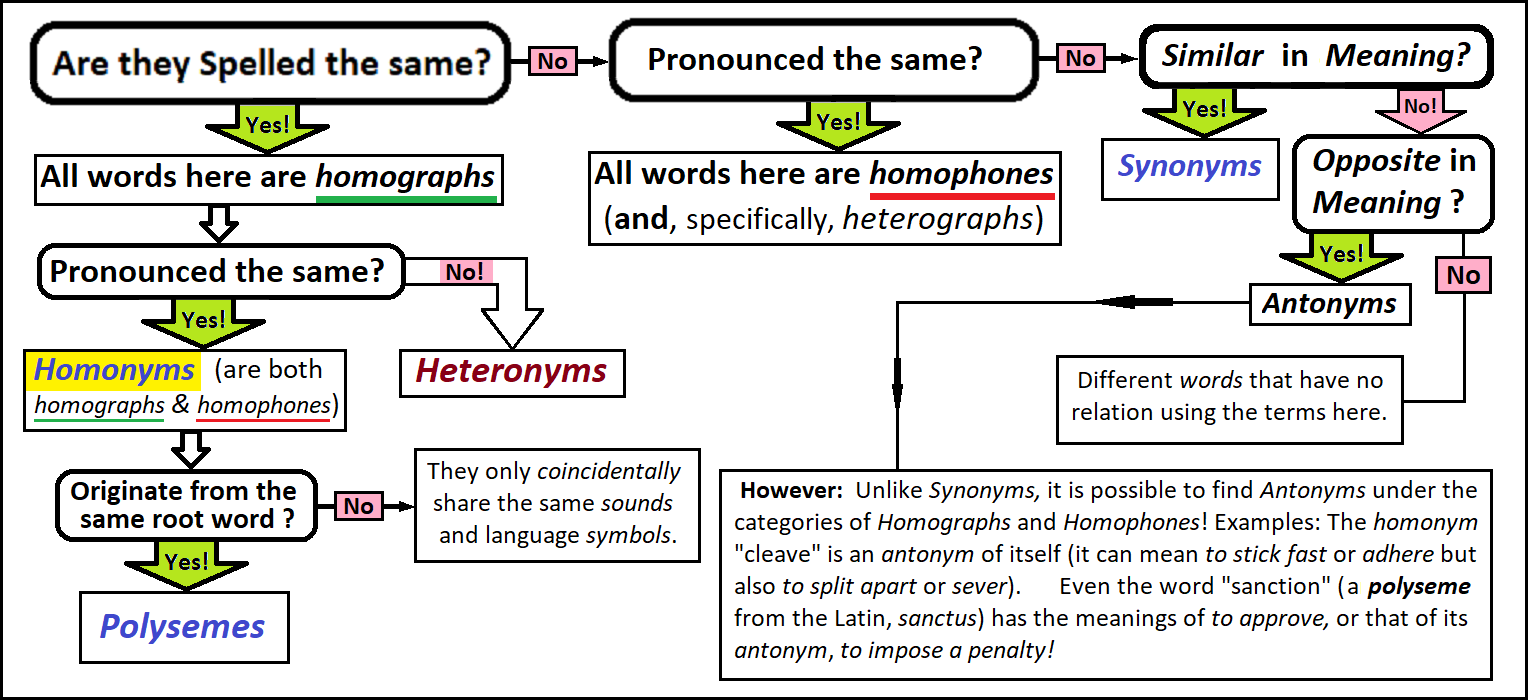
homographs — Words that are spelled the same, but have different meanings. They may or may not be pronounced the same! Both heteronyms and
homonyms might be homographs, but only heteronyms can always be categorized as a subset of homographs.
Note: Homographs must
be either heteronyms or homonyms; there are no other subcategories.
homonyms — Words which are both homographs (same spelling) and homophones (same sound; pronounced the same) at the same time, but with
different meanings. Examples of homonyms are: bat, bear, can, train and watch.
homophones — Are all the words that are pronounced the same yet have different meanings, but may or may not be spelled the same! Homophones
which are not spelled the same, would include these pairs: flower/flour, hear/here, their/there and right/write, and this set of three: two, too
and to. Though most often referred to simply as homophones, they may be called heterographs to distinguish them from homonyms.

Note: This illustration is limited to only these terms; it does not include,
e.g., the more specific term polysemes.
| Linguistics Term | Same Spelling? | Same Pronunciation? | Semantic Relationship (Meaning) |
|---|---|---|---|
General Overarching Terms | |||
| Homographs | Yes | No (Usually) | Completely unrelated (e.g., bat[animal] vs. bat[sports] |
| Homophones | Varies | Yes | Completely unrelated (e.g., to, too, two) |
More Specific Terms | |||
| Heteronyms | Yes | No | Completely unrelated (e.g., tear[cry] vs. tear[rip] |
| Heterographs | No | Yes | Completely unrelated (e.g., write vs. rite) |
| Homonyms | Yes | Yes | Completely unrelated (e.g., bank[river] vs. bank[money] |
| Polysemes | Yes | Yes | Distinct but historically related (e.g., leg of a person vs. leg of a table) |
| Antonyms | No (vast majority) | No (vast majority) | Opposite meanings (e.g., hot & cold), but does include some polysemes. |
| Synonyms | No | No | Identical or highly similar meaning (e.g., shut and close) |
Some Additional Linguistics Terms | |||
| Hyponyms / Hypernyms | No | No | Hierarchical inclusion (e.g., pigeon is a hyponym of the hypernym bird) |
| Meronyms / Holonyms | No | No | Part-to-whole relationship (e.g., wheel is a meronym of the holonym car) |
idiom — A figurative expression (a phrase; or a single word in some languages) whose meaning cannot be understood from the usual literal definitions
of those words (or word). "Spill the beans" originated as a US English idiom that actually means tell the truth about some matter. Idioms may be specific to
not only a certain language, but also certain locations. An example of a single word idiom from the Greek of the NT, in 1 Thessalonians 4:13, Paul uses koimaō
(κοιμάω); to fall asleep, to speak of Christians who have died.
See Footnote 2 for more examples; including others from the Scriptures.
itacism and iotacism — Refer to the convergence in pronunciation over time of certain Greek vowels like Ēta (η)
and diphthongs (two vowels run together) such as ei (ει) and oi (οι) into a sound
similar to the English "ee" (/i/) and the modern Greek Iota (ἰῶτα). There's only a subtle etymological distinction
between the two terms: Itacism refers to the shift of the letter Ēta to /i/, whereas iotacism refers to the letter Iota that the others shifted their sounds
into.
lemma — Is the base form of a word under which all inflected forms are indexed in lexicons or dictionaries, or that those forms point back to for a definition in
such works. ("run" is the lemma for ran, running and runs.) Another example: If you look in a copy of Bagster's The Analytical Greek Lexicon (1852), at the lower right side of page
175, you'll see many lines of different Greek forms beginning with heure (εὗρε), heuretheis (εὑρεθεὶς) and heurethē (εὑρέθη); 24 of them that
all point back to the lemma, heuriskō (εὑρίσκω) found on page 176.
lexeme — Though closely related to lemma, a lexeme refers to the abstract concept brought to mind by an entire family of word forms. Whereas
lemma refers to a single, concrete, word form chosen by linguists or dictionary editors to represent that entire family of word forms. Think abstract rather than
a concrete written or spoken word. Important: A lexeme, since it exists in minds, is the same across many languages, but lemmas may vary greatly from one
language to another for the very same lexeme.
lexical — Pertaining or relating to the words or vocabulary of a language.
lexicography — The writing or compilation of a lexicon or dictionary; the practice of compiling dictionaries.
lexicon — A complete inventory of the words; sometimes with meaningful units morphemes, or terms in a given language, a specific subject (such as a lexicon of
only medical terms), or the vocabulary used by an individual person or group (as in the Greek words of the New Testament). Note: A lexicon may or may not contain
definitions; which is what distinguishes it from dictionaries. See Dictionary.
morpheme — A meaningful grammatical element that cannot be reduced any further. Morphemes would include prefixes, suffixes and conjunctions, and may be classified as:
1) Free — Any word which cannot be separated into further meaningful pieces; which are most of them, including nouns (e,g., dog), verbs (run),
adjectives (blue) and many adverbs (now but not those with suffixes, like "-ly"), conjunctions (but) and prepositions (from). 2) Bound
— These also have meaning, but must be attached to a free morpheme to make sense; there are two types of these: A) Derivational — They
change the meaning of a word or its part of speech. These are the prefixes (e.g., "un-") and suffixes ("-ism") that might be attached to a
free morpheme. B) Inflectional — These modify grammatical properties without changing a word's part of speech; i.e., adding an "-s" to dog simply
changes its number from singular to plural, but it's still a noun. In English, these are all suffixes, such as: "-es", "-ed", "-ing" or
"-est".
Example: The word "unbreakable" can be analyzed according to the morphemes: "un-" (bound morpheme/prefix, meaning not),
"break" (the word's free morpheme or root) and "-able" (bound morpheme/suffix, meaning can be or capable of).
Linguistic morphology studies the structure and forms (including any changes and inflections) of words within a language. However, one must exercise reasonable
caution and not rely solely upon morphology in determining the meaning of a word; just as etymology has often been used incorrectly! "Awful" (Aweful is a
common misspelling) has the morphemes "aw" (awe, meaning profound fear or reverence) and "-ful" (full of; together meaning "full of
awe" or awe-inspiring), but its meaning shifted over time into meaning something horrible or just plain bad (e.g., "that left an awful taste in my
mouth"). Today, the word awesome would be its replacement.
For English morphemes (many of which have Greek and Latin origins), here's a nice:
Master List of Morphemes (derived from the work Vocabulary Through Morphemes:
Suffixes, Prefixes, and Roots for Grades 4-12 by Susan M. Ebbers).
nucleon — A general term for either of the two particles that may be found in an atom's nucleus: protons or neutrons.
parable — A short, allegorical story designed to teach a lesson. Parables rely heavily on symbolic language.
For more, see: What is a Parable?
phoneme — A unit of sound within a language that cannot be reduced any further.
PIE — In historical linguistics, PIE stands for “Proto-Indo-European”. It's the hypothetical reconstructed common ancestor of the Indo-European
language family, which includes Sanskrit, Greek, Latin, English, and many other Eurasian languages.
particle — Any type of subatomic (smaller than an atom) particle. So, a neutron can be called a particle. But elementary particles do not
include protons or neutrons, since both are composed of the elementary particles called quarks. (See: Elementary Particles)
polyseme, polysemy (nouns), polysemic, polysemous (adjectives) — These terms are used to describe a word which has several related (in various ways)
meanings; all originating from the same root word. However, homonyms (which also have the same spelling and pronunciation) are
unrelated in origin and have completely different meanings. Examples:
The most polysemous words in the English language are: run
(anticipated to reach over 645 distinct meanings in upcoming dictionary editions, making it the most polysemous word), set (430 listed definitions in the OED)
and go (368 distinct definitions in the OED).
In the Greek of the NT, ginomai γίνομαι - to be/become/happen is the most polysemous (in
BDAG, 10 main categories but a total of 33 distinct meanings when including its sub-categories). Followed by: echō ἔχω
- to have/hold (30 total, under 11 main headings and their sub-categories), pneuma πνεῦμα (29 nuances under
8 main headings). Another would be logos λόγος, which could mean something said like a word; saying; message,
teaching; conversation; or a question (after herōtaō ἐρωτάω). In 1 Timothy 5:17 it is
preaching. But it's also an account (see Heb. 4:13), value (Acts 20:24), reason, grounds, charge (Acts 19:38), matter, thing (Acts 8:21) or
even a book (see Acts 1:1). And, of course, ho logos (the Word) in John 1:1 ff. refers to the person of Jesus prior to (John 17:5) and during Creation.
And for the Hebrew of the OT: The particle kî כִּי - Depending upon the context, some of its meanings are:
because, that, if/when, but/rather and surely (in HALOT, there are 19 numbered sub-categories; it is entry #4219 and Strong's
#3588), ʿāsāh עָשָׂה (entry #7360 in HALOT) and dāvār דָּבָר (in HALOT, see entry #1948 through #1950). Just like logos in Greek, this word includes a number of the same
meanings: speech, matter, event, command, promise, decree or thing. Other polysemes of interest might be: Paneh/Panîm (פָּנֶה / פָּנִים) face/faces, front, surface, before, against, away from
and others (many different uses can be found in HALOT under פּנֶה; entry #7627), ruach (רוּחַ) breeze, breath, wind, spirit (Entry #8704 in HALOT) and nephesh (נֶפֶשׁ) people, life, soul and others (see Entry #6283 in HALOT).
Scripture — In this work, it refers to the original Hebrew (and Aramaic) contents of the Jewish Scriptures[G3] and the original
Greek works commonly referred to as the New Testament.[G4]
semantics — The branch of linguistics concerned with meaning in language; the study or analysis of meaning in words, sentences, etc. Within linguistics, semantics was
in early use chiefly concerned with meaning change; it is now equally concerned with synchronic aspects of meaning, and is one of the main branches of linguistics. The
term semantics varies in inclusiveness, sometimes covering only word meaning, sometimes including utterance and discourse meaning and sometimes including the meaning of
grammatical structures.
synchronic, synchrony — The study of a language at a specific moment in time without considering its historical development. When someone takes an introduction to the
the Greek of the New Testament or the Greek of a particular author, such as Plato, they are mostly studying Greek synchronically as opposed to the whole history of (and
changes in) the Greek language. See diachronic.
synonyms — Two or more words that have either identical or rather close meanings. This happens quite often in any language with a vocabulary that includes words based
upon those from other languages which mean the same thing. Examples: Forgive (Old English) & pardon (French), freedom (Old English) & liberty (French), floor (Old English) & level
(French), smell (Old English) & odor (Latin).
syntax — The set of rules and principles in a language according to which words, phrases, and clauses are arranged to create well-formed sentences; (also) the analysis
or study of such principles; the branch of grammar concerned with this.
Textual Criticism — TC is a good thing as opposed to those who criticize the contents of Scripture simply because they refuse to acknowledge even the possibility of what it teaches as being true. TC includes the in depth study of all the physical manuscripts (MSS) of the Scriptures which have survived; the materials used and how each character was written. Some of the NT MSS are from the 2nd-century (P66), but most of the early ones are from the 3rd (P45, P46, P75) or 4th centuries (such as Codex Vaticanus and Codex Sinaiticus). The most important aspect of TC for Biblical studies has been the comparison of every passage within all the existing MSS; noting every kind of difference between them and then reaching the conclusion that they not only mostly match with each other (in spite of their many copying errors), but that all of them agree on the doctrines taught in the NT.
token — In linguistics, a token is normally defined as every single instance of an uttered, written or printed word. So, the sentence, "I think, therefore I am, but what am I?", there are 9 tokens (counting all three occurrences of "I" and the two of "am") but only 6 different word types. In LLMs (Large Language Models; which are behind all the AI systems on the Internet these days), tokens may include not only words and morphemes, but also punctuation; anything to help it predict with a certain probability what might follow all the previous tokens in some language data string!
transliterate (transliteration) — is the process of converting a word(s) from the characters/symbols of one language into those of another. This may or may not
preserve how the original word was pronounced. For many 'Western' languages, since they mostly use the same alphabetical characters today, very little or no conversion is
necessary; unless you are attempting to preserve the original pronunciation as well (which can be quite difficult for some words). But for Greek and Hebrew, all their characters
must be be changed into various Latin letters and even specialized symbols; Hebrew can be transliterated a number of different ways, depending upon how accurate you wish to
transmit the actual spelling of say the Masoretic vowel points!
"Logos" is a transliteration of the Greek λόγος;
which in certain contexts may be translated as "Word" in English. Names and locations in the Scriptures make up the largest group of transliterations. But there
are also some words which most translators decided to simply transliterate rather than translate into English! Because it is used most of the time as a descriptive
title in the NT, the Greek word Χριστός (Christos) has been transliterated as "Christ" rather
than translating it as an "anointed one" or Messiah (which is how all the early readers of the NT would have understood it, since it's the same word used in the
Greek translation of the Hebrew Scriptures; i.e., the Septuagint or LXX, for an "anointed" person: Māshiyach מָשִׁיחַ).
The Greek verb βαπτίζειν
baptizein (or βαπτίζω baptizō; it's first-person, singular, present form) is almost always merely
transliterated as "baptize" in English Bibles. The few exceptions are where the context favors a washing, for example, of only the hands (see Luke 11:38)
or feet or what some would consider a ceremonial act (but Mark 7:4 could certainly have a healthy advantage as well); though niptō (νίπτω; cf. Mt. 15:2; John 13:5-6, 8) is most often used in such contexts. But in most contexts, "baptize" would be
translated as dip, immerse, submerge or plunge. As a title, "John the Baptist" seems more appropriate than John the Immerser or John the Plunger,
but for most passages, not translating this word was obviously done to preserve traditional practices of baptism without having to explain them in light of what the
word actually meant. The same Greek word was used in the LXX of Isaiah 21:4 to translate the Hebrew word bi’athātheniy (בִּֽעֲתָ֑תְנִי; lexical form: bāʿath בָּעַת) with a metaphorical sense of being overwhelmed (how many Bible versions have translated it there).
Other
words in the NT and OT that are most often transliterated are: angelos ἄγγελος (messenger),
apostolos ἀπόστολος (Apostle, from the verb apostellō ἀποστέλλω to send, send out) and diakonos διάκονος (servant, minister); transliterated as deacon. amēn ἀμήν (truly) is from the Hebrew word amēn אָמֵן,
hallēlouïa ἁλληλουϊά (Revelation 19:1, 3, 4, 6; transliterated as Hallelujah! for
which the "-jah" is pronounced like yah in English) or simply allēlouia αλληλουια
(21 times in the LXX from Ps 104:1 to Ps 150:6) from either Hebrew phrases such as the "hallu eth-YHWH" הַֽלְל֣וּ אֶת־יְ֭הוָה found in Psalm
117:1 or Hebrew words such as הַֽלְלוּ־יָֽהּ; hallu-yāh in
Psalm 117:2 (all of which could be properly translated as: Praise the LORD! And sabbaton σάββατον,
often transliterated as Sabbath. Hebrew: Shabbāthōn שַׁבָּתוֹן;
from the verb shāvath (שָׁבַת); which means to cease, to stop. The word being defined in Exodus 16
(and then many other passages of Scripture) as the day of rest; as commanded by God for Israel, and explained in Exodus 20:11; 31:17.
Lastly: Some words in our Bibles
have been transliterated simply because the translators had no idea what the words meant!
word — In its most fundamental sense, a word refers to the most basic independent unit of meaning comprised of one or more sounds (phonemes) or written symbols
(graphemes) that convey meaning to a listener or reader. In this sense, a word may have many different meanings, depending upon the context it is used in. However, the
term word itself may also be defined linguistically as the specific meaning intended by a speaker or author; or, as best one can determine from all of its
contextual data. These two senses are often interspersed and left only to the context for distinguishing between them.
“Word” (capitalized) may refer to Jesus, as the second person of the Triune God as it does in John 1:1-14 [see my comments about the word
person on the first two pages of Problems People have with the Trinity Doctrine]. There's also the way it's used in
phrases such as “Word of God” or “God's Word” to refer to all of Scripture (by beginning with passages such as 1 Kings 12:22 and using either metonomy
or synecdoche to call everything in the OT/NT Bible, the “Word of God”).
Footnotes
1[Return to Text] “Fire” in Greek (pur) and the
verb puroō (πυρόω Perfect passive: πεπύρωμαι;
1st aorist passive, ἐπυρώθην; only passive in the NT: make fiery hot; literally, be destroyed
by fire, be burned up [see 2 Peter 3:12], or of refined metals becoming fiery hot [see Revelation 1:15; 3:18]*) despite
their similarity to the English word “pure”; which is partly a borrowing from both French (pur) and Latin (pūrus; "clean, unmixed, spotless";
from which many other languages also get the word), etymologically have nothing to do with each other! The origin of “pure” is believed to come from the
Proto-Indo-European root *peue- or *peu̯h2-, meaning to cleanse, or purify, whereas the Greek pur originated from the Proto-Indo-European root for
fire: *péh₂wr̥-. There are, however, a number of English words which we do get from the Greek word when you consider that many transliterations of the Greek
letter upsilon use a y rather than a u: Thus we get the English words “pyre” and “pyro-” from this Greek word; even though the two only
share that distant common Proto-Indo-European ancestor mentioned above, rather than descending from it.
*Additionally, there are
a few references to being refined or purified (Hebrew, zāqaq, זָקַק) by fire (Hebrew,
ʾēsh, אֵשׁ) in the Greek translation of the OT, the Septuagint (LXX), such as, Psalm 12:6 (11:7 in the Hebrew
Text), which contains the phrase: “πεπυρωμένον (pepurōmenon; refined by fire)
δοκίμιον (dokimion; tested)” and Malachi 3:2-3 which include the words pur (fire),
chōneutērion (χωνευτήριον; a smelting furnace) and katharizō
(καθαρίζω; to cleanse, purify).
2[Return to Text] Or, a group of words in the case of idioms; such as the American English phrases, “get the hang of it,” “drop the ball” (many US idioms come from the sport called baseball), “play it by ear” or “pass the buck” among many others. An example of one idiom also found in German and Dutch cultures is: “let the cat out of the bag”. But there are also a number of idioms in the Scriptures, some of which became wide-spread in other languages as well. For example, in Isaiah 40:15, the Hebrew phrase kəmar middəlî (כְּמַ֣ר מִדְּלִ֔י) was translated into Greek as hōs stagōn apo kadou (ὡς σταγὼν ἀπὸ κάδου; as a drop from a container) which in the Geneva and 1611 AV became “as a drop of a bucket” and in later translations, “like a drop in/from a bucket” and eventually became the common idiom shared by many languages: “like a drop in the ocean/sea.” Likewise, there are a number of idioms in the NT as well. 1 Peter 1:13 begins with Dio (therefore) anazōsamenoi (having girded up) tas (the) osphuas (loins) tēs (of the) dianoias (mind) humōn (of you) (Διὸ ἀναζωσάμενοι τὰς ὀσφύας τῆς διανοίας ὑμῶν). But that idiom has been interpreted for you in some later English translations; for example, the ESV reads, “Therefore, preparing your minds for action,” though it does include the note: “1Greek girding up the loins of your mind.” For more on other idioms in the Scriptures see here.
3[Return to Text] Many elements have some naturally occurring isotopes (atoms of the same element; all having the same number of protons, but with differing numbers of neutrons). More than 98.98% of all hydrogen atoms have only a single proton as their nucleus; this isotope may be referred to as protium. About 0.0115% have both a proton and a neutron; this isotope is called deuterium (symbolized as 2H, where the superscript on the left side always indicates the total number of both protons and neutrons). Water (H2O; technically, dihydrogen monoxide) when composed of high concentrations of deuterium is called heavy water. Only trace amounts of tritium (3H; hydrogen with two neutrons) are found naturally. The atomic number of any element, such as 82 for Lead (Pb), indicates how many protons there are in its nucleus which determines the kind of element it is. Two protons, that's Helium, 3 protons, it's Lithium; 6, Carbon; 7, Nitrogen; 8, Oxygen, etc. And when examining increasingly heavier elements, the ratio of neutrons to protons also increases. 208Pb has 208 - 82 = 126 neutrons in its nuclei. Lead has the highest atomic number of all stable elements (atomic numbers 83 or higher are all radioactive). Note: My description of an atom as an electron cloud surrounding a nucleus is a simplification. In reality, there are different sizes, shapes and numbers of what are called shells that an increasing number of electrons must fill around the nucleus.
4[Return to Text] Some of the more technical aspects of these
subatomic particles are as follows: Proton mass ≈ 1.67262 x 10⁻²⁷ kg, Neutron mass ≈ 1.67493 x 10⁻²⁷ kg. For
the elementary charge (e) on protons and electrons, that is equal to 1.602176634 x 10⁻¹⁹ Coulomb; the same exact value but with Joule being the unit we
use to define an electronvolt (eV).
Also note that certain atoms are called ions
if they do not have the same number of electrons and protons to balance the charge on them; either negative (an atom with one or more extra electrons, may
be called a cation, which is related to the word "cathode") or positive (an atom having one or more less electrons than normal, and called an
anion, which is related to the word "anode"). The most common example of this would be dissolving table salt (sodium chloride; NaCl) in water which results in
many individual ions of sodium (Na+) and chlorine ions (Cl-). Such a solution will conduct electricity: And after inserting conductors
connected to a voltage/current source into the solution, chlorine gas (Cl2) will form at the anode (positive electrode) and hydrogen gas (H2) at the cathode
(negative electrode). The remaining ions of sodium and part of the water turn the solution over time into a higher concentration of sodium hydroxide (NaOH) as more hydroxide
(OH-) ions are left in what remains of the water. However, if you start with a solution of sodium carbonate (Na2CO3; also called
washing soda at grocery stores), that will produce oxygen (a much safer gas than chlorine) at the anode and again hydrogen at the cathode. This reaction will only leave higher
concentrations of sodium carbonate as the water is converted into those gases; no byproducts. CAUTION: Never leave any remains of such electrolysis experiments unattended!
Always flush the solutions down a toilet; especially if any children could access them! I'd be happy to answer any questions on this topic, or if you'd like to go through some
history and the basics of chemistry, I'd recommend the free online, 9 lesson course, covering atomic theory, the periodic table, chemical bonds, and the molecular basis of life,
called The Great Principles of Chemistry from Hillsdale College.
Regarding the
size ratio of an atom to its nucleus (and its mostly empty space): For a hydrogen-1 atom, if its proton were the size of regular garden pea (10 mm or 1cm wide), its
outer layer (the cloud where its electron might be located) would be a sphere about 63,000 times larger than that pea; with a diameter of about 630 meters (2,066.92 feet or
the length of about 5.74 US football fields). And for an atom of Lead-208, its nucleus having 208 nucleons (protons and neutrons) tightly packed together in a diameter of only 6.5
cm (2.56 inches), its outermost cloud could extend to a diameter of about 1,042 meters (3,418.6 feet, or about the length of 9.5 football fields)! Calculations for
determining the widths of atoms include a number of factors, such as the type of bonds being considered and other variables, so these are estimates to provide you with a picture
of just how truly empty atoms are.
5[Return to Text] The topic of this essay concerns the
interpretation of words in literature; especially the words found in the Scriptures. But for those who might have further questions about neutrons, here are some brief
answers to the most important ones:
"How are free neutrons created?" Apart from nuclear fusion (what happens in stars), researchers at the Oak
Ridge National Laboratory (ORNL) have either the Spallation Neutron Source (SNS; which uses a
high-energy proton accelerator to strike mercury or tungsten targets), or the High Flux Isotope Reactor (HFIR; a
nuclear fission reactor, which uses 235U, Uranium-235, to produce a continuous, steady-state stream of neutrons) available to them.
Note: Be aware
that any article or video this page links to may contain a worldview diametrically opposed to that of the Scriptures! Such as, the belief that everything in the universe is
only the evolutionary result of an event called the big bang and not its Creation by God as described in Genesis.
"But how can neutrons with zero charge be
contained or manipulated?" Although they have no charge, neutrons do have magnetic dipole moments, which means they are effectively tiny magnets. That allows them to be
trapped or manipulated using inhomogeneous magnetic fields.
"How can physicists know what particles a neutron decays into when it is impossible to view those
particles even with the most advanced electron microscope?" Some particle accelerators have used cloud chambers (containers filled with supersaturated alcohol
vapor, in which charged particles like an electron ionize the gas, causing condensation and forming a visible trail or path — all of which are filmed with high speed cameras).
And particles produced in certain decay experiments can be directed to strike certain materials which emit light. The tiny flashes of light are amplified and counted by sensors
(photomultiplier tubes) calibrated in a way to show both the energy and the type of particle. Due to the charges on protons and electrons, those particles can be guided by
magnetic fields from a source of neutrons to specialized detectors where they can be counted.
For more details, see Free Neutron Decay.
6[Return to Text] However, the spelling of many different words (and more importantly the meanings of some), have changed throughout the history of various languages! For example, by comparing the Middle-English Wycliffe translation of the NT (from the Latin Vulgate; see here for original hand-written pages of a 1410 edition) with the Tyndale NT (if you go here and enter "Tyndale" in the search box, you can view photographs of original pages), Geneva Bible (see here for a facsimile copy of the 1560 edition) and the later Authorized Version (for photos of every page of an original 1611 Bible, see here), one can find obvious changes in the spelling of many words that have the same meaning. The illustration below, provides examples, such as: "walkide" (walked), "bisidis" (besides), "see" (sea), "sai" (saw), "twei" (two), "weren" (were), "seide" (said), "maad" (made) and "hym" (him). These would also include the letter thorn (þ); which may appear similar to the letter "y" in handwritten documents, but could easily be distinguished from the words "ye" (second-person, plural, nominative, personal pronoun) and "you" (versus "thou") since at that time the distinctive letter Yogh (which looks like the numeral 3) was also in use at the beginning of such words. After the invention of the printing press, "y" was often used in place of thorn (see the few occurrences of "ye" where used in the 1611 AV, but only for page formatting problems; having already been replaced by "th" in much earlier printed books, such as the 1557 Geneva NT). And for many centuries (from the 8th until into the 19th) the letter "s" at the beginning of a word ( ſ ; called a long s) and elsewhere looked quite similar to an " f " as in the "ſee [sea] of galilee" below or the first word on the 6th line: "ſchal" (shall).
 | Matthew 4:18-20 in a Wycliffe NT (c. 1410). In this illustration, the RED squares show the use of the letter "Thorn" in the words "the", "that" and "thei" (they). The BLUE squares contain the letter "Yogh" in the words "Ye" and "you". The first enclosed word is the name Jhesus (which may look like "air" to you), but it's actually an abbreviation (indicated by the bold dot above the word) using the letters "j" (appears as an i without any dot) "h" and either an e or an s. The two words in YELLOW squares are examples of abbreviation as well ("briþen" for brithren and "broþ" for brother). |
For the very nerdy among you: Three words in the sample above are not merely differences in spelling: "clepid" (means called or named from the past participle of the verb clepen), "anoon" (or anon; meant: at once, immediately, right away) and "sueden" (in this context, meant to follow, but in other contexts it can be seen as the origin of our legal term to sue; bring a law suit).
Note: There are some words, which not only have two completely different meanings, but are also pronounced differently depending upon their meanings; these are called heteronyms. One such word is “lead” which can be either a noun for the chemical element of atomic number 82, or a verb for leading someone or something to somewhere (apart from any figurative uses). Another example is the word “minute” which as a noun refers to 60 seconds of time, but as an adjective refers to something very small, such as a tiny grain of sand. There are also some words which are pronounced the same, but spelled differently. These are often called homophones (though technically they are only a subset of that term and are more specifically heterographs). Examples of these are: The verb led (past tense of lead) and the chemical element lead (82Pb), write/right, see/sea, knew/new and to/too/two. These have always been a bane to anyone copying words from a verbal only source, or more recently for any voice recognition software since its beginning, and can still cause problems today. Lastly here, there are homonyms which are both spelled and pronounced the same, but also have completely different meanings. A “bank” might refer to a financial institution or the side of a river or lake. And “watch” could be either a verb for observing something or a small personal instrument for noting the time. See our Glossary for more complete definitions of these terms. [Return to Text]
7[Return to Text] In the analogy above, what happens to a neutron in different environments is seen as the different meanings a word may have in different contexts. But, one might say that the analogy of comparing stable neutrons to words breaks down, since the meanings of many words have changed over time! Yes, that's true, but time itself is part of the literary context as mentioned in the Preface as “history” (when a particular word was used may also be an important part of its context). So, the comparison is still valid.
8[Return to Text] Decades ago (AUG, 1974), I was required to go on a cruise to Hawaii; not the kind you're likely thinking of (it was on a US Navy destroyer!). However, I had shore leave for two whole weekends on Oahu, and while spending time with other Christians at a local church, I was invited to a Bible conference through their college. During that weekend, I heard a talk by Loren Fischer, who had come from Western Conservative Baptist Seminary, about "The Cycle of Communication"; which I never forgot: Communication without understanding (often gained by feedback and message adjustment) is really no different than a mere emotional experience among many in our lives! Or, maybe worse, if you completely misunderstood what a speaker had hoped to communicate! ("I.B.C." = International Bible College, co-founded in 1971 by Dr. James R. Cook while pastor of the International Baptist Church in Honolulu.)

9[Return to Text] Norman Geisler, To Understand the Bible Look
for Jesus: The Bible Student's Guide to the Bible's Central Theme (Baker, 1979; reprinted from 1968). On a personal note: I didn't put a link to the most recent printing,
because there is a caricature of Christ on the cover, and I believe that attempting to represent the Lord Jesus in any type of drawing or especially by some human actor is
almost idolatry (in your mind, that human or drawing could easily become your picture of Christ rather than who He truly is). So, I'd prefer one look for a used copy (the cost of
the new one is far too much in my opinion!) with this cover:
10[Return to Text] At that time he referenced only Nehemiah 10:32 (10:33 in the Hebrew Text); which contains the phrase shəlishiyth hasheqel (שְׁלִשִׁ֥ית הַשֶּׁ֖קֶל) meaning 1/3 of a shekel in order to explain some things about weights in Israel. Note: Macalister's footnote on p. 267 is missing; a publishing error, but it most likely would have described the fact that in the Hebrew Scriptures we find only a term for half a shekel, a bekah (בֶּקַע) and none for any other fractions of a shekel. And even then, that word is only used in Genesis 24:22 and actually defined as such in Exodus 38:26: “One beka per person, that is, a half shekel...” (NET Bible). So it was quite common for the Israelites to describe such weights using phrases like the one he cited from Nehemiah. Macalister did, however, in a later work published in 1912, The Excavation of Gezer, Vol. II, 1902—1905 and 1907-1909, mention that “A similarly inscribed weight of bronze, rather heavier, was found in Jerusalem. The inscription is interpreted by Prof. Clermont-Ganneau (Receuil d’archéologie orientale VII § 14) as meaning "twothirds." ”
11[Return to Text] The phrases "fell from heaven" or "fell from the sky" are translations of the single Greek word: diopetous (διοπετοῦς); used no where else in either the NT or the Greek translation of the OT (the Septuagint). There are, however, a number of ancient Greek words that begin with Dio- (Διο-) or Dios- (Διόσ-) and the fact that Διόσ is the genitive form of Δίς, an old nominative word for their god Zeus (Ζεύς). Thus we find words like Diopais (Διόπαις); meaning son of Zeus, or Diosēmia (Διοσημία); meaning a sign from Zeus, or simply an omen from the sky about sudden storms with lightning and thunder. From the context of ancient Greek authors like Plutarch, Pausanias, Homer, Euripides and Aristophanes, who either used this same or similar Greek words, it's quite clear that diopetous refers to something that "fell from Zeus" or simply "fell from the sky."
12[Return to Text] Exegesis is a combination of the Greek ex (ἐξ) meaning out of with an anglicized form (-egesis) of the Greek word hēgeomai (ἡγέομαι); a verb that can mean to lead or to guide. Thus, one who exegetes allows the Text itself to lead or guide one out of what is found there to its intended meaning. That is in contrast to the term eisegesis which combines eis (meaning into from the Greek preposition εἰς) with that same anglicized verb form. So one who already has their own ideas of what a Text teaches and is merely looking for some passage or phrase to support their beliefs is a person that practices eisegesis rather than exegesis.
13[Return to Text] Individuals or groups which fit into this last
category would include:
1) Those who Deny the Triune Nature of God but not Christ's Deity — This heresy is known as modalism but it began
as Sabellianism in the 3rd-century, and more recently (early 20th century), appeared as
Oneness or Jesus Only Pentecostalism,
2) Those who also Deny the
Divinity (or Eternal Divinity) of Jesus — Many groups fit into this category! Known examples from history are:
a) Ebionism (1st-2nd Century): Considered one of the earliest heresies, the Ebionites were a
Jewish-Christian sect that emerged in the late 1st century, growing into the 2nd century. They maintained that Jesus was a mere human, the son of Joseph and Mary, who was
"adopted" by God at his baptism.
b) Docetism (Late 1st-2nd
Century): While closely linked with Gnosticism, early forms of Docetism were addressed in the Johannine Epistle of 1 John at the end of the 1st century. Docetists
argued that Jesus only seemed to have a physical body but was actually a a purely spiritual being, thus denying his true humanity, but also calling into question his divinity.
c) Gnosticism (2nd Century): While having roots in the 1st century, Gnosticism grew
as a prominent heresy in the 2nd century. Gnostic groups, such as the Valentinians,
viewed the material world as evil, arguing that a divine redeemer could not have a material body, and often separated the heavenly "Christ spirit" from the human
Jesus.
d) Adoptionism also known as the Theodotians (Late
2nd-3rd Century): Associated with figures like Theodotus of Byzantium (c. 190 AD), this form of Dynamic Monarchianism taught that Jesus was a mere man until the Holy Spirit descended at his baptism, at which point he was adopted into divinity. So,
although not outright denying Christ's divinity, they never believed in his eternality! Paul of Samosata (3rd century) was a later proponent of this belief as well.
e) Arianism (Early 4th Century): Promoted by Arius of Alexandria (c. 250-336), this
heresy became a massive crisis in the early 4th century. Arianism taught that Jesus was not co-equal or co-eternal with the Father, but rather the first and highest created being.
f) Socinianism (16th-17th Century): Emerging during the Reformation,
this movement was spearheaded by Laelius and Faustus Socinus. It is a much later form of the rationalist belief that denies the Trinity and the pre-existence of Christ, viewing
Jesus as a mere human who was divinely inspired. Unitarianism is a more recent name for this
heresy.
g) A more recent and often encountered group in Western countries that denies the deity of Jesus would the Jehovah's Witnesses (who
needed to create their own version of the Scriptures in order to overtly deny what is clearly taught about the divine nature of Jesus the Messiah).
3) Those Who
Totally Twist and Misuse the Scriptures — Groups or individuals who treat the Scriptures in this way often seek to gain some kind of authority
for their preconceived notions which are often directly opposed to the proper understanding of what the Scriptures mean and teach us about God, sin and salvation! Two such groups
that come to mind are:
a) Christian Science; which is neither
Christian nor in any way scientific! Not only do they deny what Scripture teaches about Jesus, but also everything about sin and salvation! The words and context of the Scriptures
are completely re-defined. They deny the need for Jesus as the substitutionary atonement for sin, since they believe that both sin and even death are simply an illusion!! They in
fact are supposed to believe that the material universe is entirely illusory and that reality is purely spiritual. The God described in Scripture is to them only a divine
Principle, not a personal being! This would be a prime example of someone interpreting Scripture to mean whatever they wanted it to, rather than how its authors
intended.
b) LDS (Mormonism): Their beliefs are so directly opposed to those taught in the Bible, that they had to invent their own Scriptures:
For example, they not only believe in the eternal existence of matter, but that God (the Father) has always had a body and was at one time no different than them and that they can become just like him! Thus, it's the most polytheistic religion ever dreamed up by man.
4) Many other
examples of those who have no interest in seeking the truths that God Himself intended for us to learn from Scripture could be provided. But the point here is that one should
always approach any passage in the Bible with a desire to learn from (and possibly be changed by) its words rather than trying to find some kind of proof for whatever one already
wants to believe from sources outside of it. What we believe about God, sin, the Holy Spirit, Jesus, the reason for the incarnation, the Gospel, faith and salvation
must come from within the Scriptures by properly interpreting them according to their context; not placing any of our own biases into them!
A great quote
from Scripture concerning those who misuse it would be: 2 Peter 3:15-17 (“There are some things in them [referring to some of the Apostle Paul's letters] that are hard to
understand, which the ignorant and unstable twist to their own destruction, as they do the other Scriptures.” 2 Peter 3:16b; ESV)
An appropriate resource
for the topic here: Scripture Twisting: 20 Ways the Cults Misread the Bible by James W. Sire (©1980; InterVarsity Press). D.A. Carson refers to this book three times
in his Exegetical Fallacies.
[Return to Text]
B1[Return to Text] Joshua Lindsey did a lot of research to provide summaries from many different articles at Got Questions pertaining to all the major theological viewpoints one might wish to know about the beliefs that this website holds to in relation to all major Christian denominations: Who Are These Guys?
B2[Return to Text] Overall this is a very useful book on Biblical interpretation; including some exercises in chapters 5, 7-8, 11 (with answers in the back of the book). However, I would disagree with his comments that begin with: “More than regeneration is necessary. Also reverence for and interest in God and His Word are essential for interpreting the Bible properly.” (on p. 23). Unless the person in mind is an outright sinning and prideful Christian at a particular moment in time, then I must ask: "What true Believer would not want to know more about God and be interested in studying His Word?" There's no need for thinking of Christianity as being composed of different levels of those who are simply 'saved' and those who are more spiritual and thus have a means for understanding the Word that other Believers do not.
G1[Return to Text] Christians have often wished that Paul,
Luke and other NT authors had left us glossaries for their combined works. However, there are many passages within the NT that allow us to create a glossary of a number of
Biblical terms based upon very clear contexts in which its authors have used or even defined them. For example, a definition of the term “Christian” (Christianos
Χριστιανός, -οῦ, ὁ) is given by Luke in Acts 11:26 ("Now it was in
Antioch that the disciples were first called Christians." NET Bible; Luke having
already defined disciples as followers of Jesus — and all that implies — in his Gospel; see e.g., Luke 9:23). And by the time Paul gave the most complete
description of his conversion (before King Herod Agrippa II, his sister Bernice and Porcius Festus; see Acts 25:23 — 26:32 for context, but specifically Acts 26:12 ff.),
Agrippa himself uses the term “Christian” in Acts 26:28. Peter also used the term in 1 Peter 4:16.
But there are still a handful of terms in the NT (and more in the OT) for which we do not have an exact idea of what their author was referring to.
G2[Return to Text] Another example which shows how different
pronunciations due only to syllable stress can alter the meaning of a word:
In German (Deutsch), there are many words with prefixes that can have the prefix
placed separately in another part of a sentence or remain connected as a single word. In the case of umfahren, stressing the prefix (um) indicates this is the separable
word (it could be split apart) and it means to hit, run over or knock down (something or someone)! But, stressing the second syllable of this word (fah), would
indicate it's being used as the inseparable word which means to drive around, bypass (something or someone).
G3[Return to Text] Also referred to as: The Law, the Prophets and
the Writings; the order of its books in most Jewish publications being: Genesis, Exodus, Leviticus, Numbers, Deuteronomy (which comprise the Torah or the
Law); Joshua, Judges, I & II Samuel, I & II Kings, Isaiah, Jeremiah, Ezekiel and The Twelve (Hosea, Joel, Amos, Obadiah, Jonah, Micah, Nahum, Habakkuk, Zephaniah,
Haggai, Zechariah, Malachi), Psalms, Proverbs, Job, Song of Songs, Ruth, Lamentations, Ecclesiastes, Esther, Daniel, Ezra, Nehemiah and I & II Chronicles (which
in most Christian Bible translations, though separated into the same 39 books, have them in a different order — which has been used below); often referred to as the
Old Testament by Christians. Together, these texts trace the history of Creation, God’s Covenant with Israel and look forward to the promised Messiah. But note
that passages within these books can still have relevant applications for the lives of all Believers. Here's a brief survey of their contents:
1. The Pentateuch (First 5); also known as the Torah or the Law.
These books trace the origins of the world, the history of the Patriarchs, the birth of Israel as a nation, and the giving of the Law.
● Genesis: Covers Creation, the Fall, and the lives of Abraham, Isaac, Jacob and Joseph.
● Exodus: Details the Israelites’ escape from slavery in Egypt and the giving of the Ten Commandments.
● Leviticus: Establishes laws regarding sacrifices, holiness and the duties of the priesthood.
● Numbers: Records the wilderness wanderings of the Israelites and their preparation to enter the Promised Land.
● Deuteronomy (cf. Exodus): The final speeches of Moses, reminding the new generation of God’s laws and promises.
2. The Historical Books (12 of them): These books cover the history of the nation of Israel from their conquest of Canaan, the era of the kings, their exile into Babylon
and their eventual return.
● Joshua & Judges: Describe the conquest of Canaan and the cycle of judges who ruled Israel before they demanded a king.
● Ruth: A personal story set during the time of the judges, highlighting God’s grace and the lineage of King David.
● 1 & 2 Samuel and 1 & 2 Kings: Trace the rise of the monarchy (Saul, David, Solomon), the division of the nation into Israel and Judah; and the eventual fall of both to foreign
empires.
● 1 & 2 Chronicles: Retell the history of Judah, focusing primarily on the Davidic line and the Temple worship.
● Ezra, Nehemiah, & Esther: Detail the return of the Jewish exiles to Jerusalem, the rebuilding of the Temple walls, and the preservation of the Jewish people in Persia.
3. Poetic and Wisdom Literature (5 books): These writings focus on practical life skills, worship, suffering, and the human experience.
● Job: Explores the problem of human suffering and God’s Sovereignty.
● Psalms: A collection of prayers and hymns used for worship and expressing human emotion concerning many common experiences in life.
● Proverbs: Practical guidelines for wise and righteous living.
● Ecclesiastes: A philosophical look at the meaning of life, but concluding that true joy comes from fearing God.
● Song of Solomon: A poetic exploration of the beauty of human love and marriage.
4. The Prophets (17 books): Categorized generally as the Major (meaning only longer) and Minor (meaning shorter) Prophets. These books contain messages of
warnings against unfaithfulness, calls to repentance and predictions of future judgment and deliverance.
● Major Prophets: Isaiah, Jeremiah, Lamentations, Ezekiel, and Daniel. These include major predictions regarding the coming Messiah and Israel’s
relationship with surrounding nations.
● Minor Prophets: Hosea through Malachi (12 books). They address the social and spiritual conditions of Israel and Judah, emphasizing God’s justice and ultimate
redemption.
[Return to Text]
G4[Return to Text] These works include the writings and letters
of some of Jesus’ Disciples (Matthew, Peter and John) and the Apostle Paul; all from the First Century, and have been grouped into 27 books in the following order:
First, The Gospels of Matthew, Mark, Luke and John, then the early history of the Church, the Acts (of the Apostles). Next, the Letters of Paul: Romans,
1st & 2nd Corinthians, Galatians, Ephesians, Philippians, Colossians, 1st & 2nd Thessalonians, 1st & 2nd Timothy, Titus and Philemon. Then the book of Hebrews (whose
author is uncertain), followed by the letters of the Apostles Peter and John and other authors in this order: 1st & 2nd Peter, James, 1st, 2nd & 3rd John, Jude and
Revelation. They contain an historical survey of the life of Jesus, the birth of the early church and letters offering theological instruction to early Christian
communities. Here's a brief survey of their contents:
1. The Gospels (4 books): Matthew, Mark, Luke and John. These four accounts detail the life, ministry,
death and resurrection of Jesus Christ. They highlight his identity as the prophesied Messiah and establish the foundation of the Christian faith.
2. Historical Narrative (1 book): Acts of the Apostles which chronicles the birth of the Church following the ascension of Jesus into Heaven. It details the
spread of Christianity from Jerusalem across the Roman Empire.
3. Pauline Epistles (13 books): Romans to Philemon. Letters written by the Apostle Paul to various
churches and individuals. They address theology, church discipline, Christian living, and encouragement.
4. General Epistles (8 books): Hebrews to Jude. Letters
written by other early church leaders (including Peter, James, and John) addressed to a broader audience rather than specific local congregations.
5. Prophecy (1 book):
Revelation. An apocalyptic text that uses symbolic visions to communicate the ultimate triumph of God over evil and the promise of a renewed Creation.
First Published on: 25 JUN 2026 (2026.06.25).
Updated on: 27 JUN 2026 (2026.06.27); added new diagram (Free Neutron Decay) and a more Glossary definitions, 8 JUL 2026 (2026.07.08); added transliteration
definition, 11 JUL 2026 (2026.07.11); clarifications, typos, new footnote, 16 JUL 2026 (2026.07.16); added a few more references, 19 JUL 2026 (2026.07.19), 24 JUL 2026
(2026.07.24); added John 8:32 example.
You can write to me here: contact page (opens in a new window).